Your Radio Listeners at Home
Ofcom, this week, released their annual Digital Radio report.
When I looked through it I was quite pleased with it. Press coverage has been less than friendly emphasising a decline in DAB set sales. I read the data slightly differently. I read that set sales were pretty flat, we sold around the same this year as last year (another 1.9m!) but that radios that were analogue-only took a big hit - selling a million less than the previous year - but still a lot.
But, to be honest, I think there are so many things that have a knock on to what people buy that you can probably argue strongly either way that this is good news for DAB or terrible news.
As most radio listening is in home - 63% of all listening happens there, whilst only 21.2% is in car and the remainder at work or somewhere else - I thought I'd look particularly at in-home listening. It's not something I had done before.
The big shock for me was reach.
So, radio has a 90.8% reach in the UK.
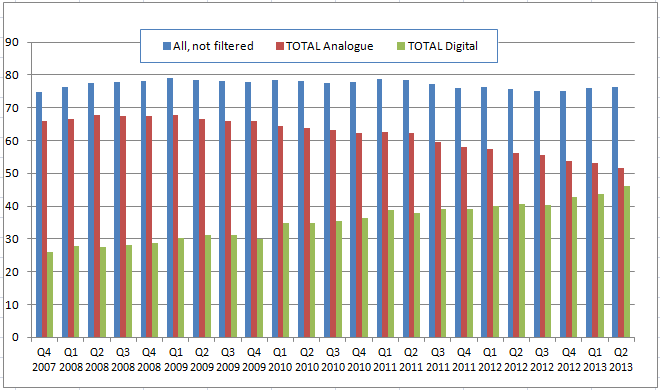
In home, radio has a 76.3% reach. That means 76.3% of the UK population listen to the radio, in some form, at home in an average week.
I thought I'd then look at 'Total Analogue' and 'Total Digital' reach.
The result is that analogue radio (AM and FM) only has a 51.7% reach in homes.
So only half the country, in radio's most-popular location, during an average week, listen to ANYTHING on AM or FM.
I was quite surprised by this, I always assumed that analogue radio reach was going to remain relatively high through to digital switchoverm even if the volume of consumption kept dropping as people started to listen to more digital radio. After all, surely most people will hear 5 minutes of radio from an analogue set at some point in a week? At the moment when we look at total analogue reach in every location it hits 81.5%.
When we look at the percentage of the UK who listen to some form of digital radio, at home, in a week it's 46.1%. Just 5.5 percentage points lower than analogue.
What does this mean? Well, if you're a predominantly analogue-only station (ie not on DAB or DTV) then you've only got a potential audience of half your TSA. Half. And it's getting worse.
Now, clearly this isn't the same in-car. Digital radio only has an in-car digital reach of 11.7%, whilst analogue is much stronger, having a 58% reach of the UK population.
Though I'm sort of surprised total in-car listening is that low - 37.7% of the UK population never listen to the radio in a car at all. Sacrilege!
As we approach some switch-over announcements, people with vested interests (of which I count myself) are going to be saying lots of things. To me, the most important thing is looking at what listeners are doing and how their use of the radio is changing.
As a station owner I will go where the ears are, on platforms I can get access to or can afford. DAB, Internet, DTV, whatever reaches the most people in the most cost-effective way, my stations will be there. There's nothing particularly wrong with FM - if you've got an FM licence, of course. It's still a big platform - though as the data shows - it's one that's getting significantly smaller each quarter.